A Professional Networking Site for Doctors & Medical Students Worldwide

Stitching a Cut
Anatomy of First Aid: A Case Study Approach
Stitching a Cut
A cook on his first deployment, was preparing some meat for a stew when he lost control of the knife and cut his hand. He stemmed the blood flow by placing a clean cloth over the cut and applying pressure above the cut. He hurried over to the sickbay to find a hospital corpsman.
The corpsman cleaned the hand with antiseptic and decided to use sutures to close the wound. The size of the cut was too large to use a butterfly tape as a skin closer. The corpsman had several types of stitching to choose from (see illustrations):
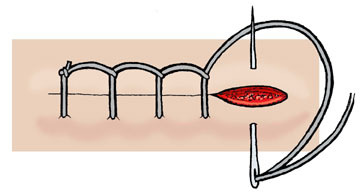
Sutures A: a lock-stitch
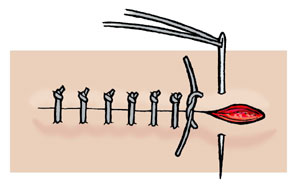
Sutures B: an interrupted stitch
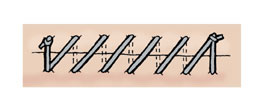
Sutures C: a continuous stitch.
An interrupted stitch (B) was thought to be the best to close this cut.
The corpsman used a sterilized needle and suture. A stitch was made through the skin (avoiding the superficial fatty fascia as much as possible) at the midpoint of the wound and the edges of the wound drawn closely together. The thread was knotted (square knot) and cut. The corpsman continued until he completed the closure and covered the wound with sterile gauze. The gauze was taped to keep the injured area clean. The corpsman advised the cook to inspect his hand daily for signs of infection (inflammation, heat, pus and no sign of healing). A serious infection may require stitches to be removed to drain the infected site.
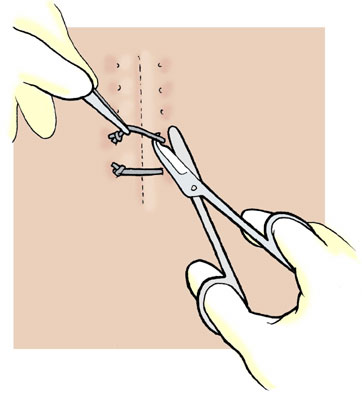
Sutures D: remove stitches
After 7 days, the corpsman had the cook return to sickbay to remove the stitches using the technique shown in the last illustration (Sutures D). It is important to cut the sutures as shown to reduce the possibility of infection. Before removing the stitches however, the injured hand was again cleaned with antiseptic. Pull up on the knot. Slide scissors under one end with the blades parallel to the skin. Cut suture and pull knot and suture out of skin completely.
A corpsman may use the following guideline for the number of days for healing to occur before removing stitches: 5 days for face wounds, 7 days for body wounds and arm and hand wounds, and 8-10 days for leg and foot wounds.
Views: 319
Comment
- Comment by Michelle Leveille on September 1, 2015 at 7:35am
-
Hello Dr. Prakash,
Thank you for posting this information. It is my desire that it helps someone. I just ask that you please give me credit for my artwork. I created it for the Virtual Naval Hospital, to illustrate the text you copied from Dr. Ronald Bergman. More of my medical and veterinary illustrations can be viewed on my website: www.ArtifactGraphics.com




© 2017 Doctors Hangout | About DH
Powered by


You need to be a member of DoctorsHangout.com to add comments!
Join DoctorsHangout.com